Review 648: Moon Knight
By this point in the MCU, it's apparent that the various movies and Disney+ shows are becoming increasingly defined by their settings and the worlds that they take place in: Thor and Guardians of the Galaxy are very much rooted in the cosmic side, Doctor Strange is exploring the Mystical side and Moon Knight is showcasing a lot of wondrous magic pataining to Egyptology and lore regarding deities and the afterlife.
Based on the Marvel Comics character Moon Knight by Doug Moench & Don Perlin; Steven Grant (Oscar Isaac) is a mild-mannered gift shop employee, who becomes plagued with blackouts and memories of another life. Steven discovers he has dissociative identity disorder (DID) and shares a body with mercenary Marc Spector. As Steven/Marc's enemies converge upon them, they must navigate their complex identities while thrust into a deadly mystery among the powerful gods of Egypt.
Just as how Thor (2011) and Black Panther were very much rooted in Norse Mythology and African culture respectively, Moon Knight is very much rooted in its exploration of Egyptology and lore about deities and the afterlife. That coupled with its Indiana Jones inspired sense of adventure makes for a very unique experience. The idea of an Avatar is actually an ancient Egyptian idea. Every pharaoh is believed to be the God Horus. So every ancient Egyptian pharaoh is actually the Avatar of Horus and show runner Jeremy Slater and the directing team of Mohamed Diab and Justin Benson & Aaron Moorshead have taken all of these elements At its core Moon Knight is a globe-trotting adventure with a supernatural bend with elements of horror sprinkled in for good measure.
Much like Iron Man and and the aforementioned Doctor Strange, Moon Knight feels like a legitimate Marvel character-study. Marc's mental illness brings a unique aspect to the series which primarily focuses on his psychological trauma and how his duel personalities deal with that. Marc Spector and Steven Grant are entering repeated dissociative states, waking up in random places and loosing entire hours of their day. The show brilliantly analyzes Marc Spector's conceince and psyche. What is real or sense and what is unreal plays a very prevalent part in the show Marc Spector, in order to survive a horrible, horrible trauma at a very young age for which he carries a lot of guilt, built a survival mechanism that kicks into place where the brain creates other people within his psyche to be able to shoulder that trauma making Marvel’s Moon Knight a open eye, nuanced look at DID. Moon Knight is almost Marc’s Id: Him at his most unleashed, his most unfeeling, his most violent and his most vengeful. Every aspect of the show has a duality: Every person has a dual self and the story has a dual nature.
What’s amazing about this show is how the tone is established entirely out of character. From the outset, it’s clear that Moon Knight is taking place in the middle of a larger conflict with Steven Grant as our audience surrogate. We’re learning about the mythology of this character and the stakes of the story through a character who is as new to it as we are.
As the stakes rise and the heat starts notching up, the adventure takes us into a more extreme version of Christopher Nolan's Inception where you're not sure what's feeding into what and then you don't care because Isaac's brilliant performance finds the perfect balance between the ruthlessness of Marc Spector and the quirky charm of Steven Grant.
Watching the penultimate episode, Episode 5: Asylum, I was strongly reminded of the penultimate episode of WandaVision “Previously On” in which the main character
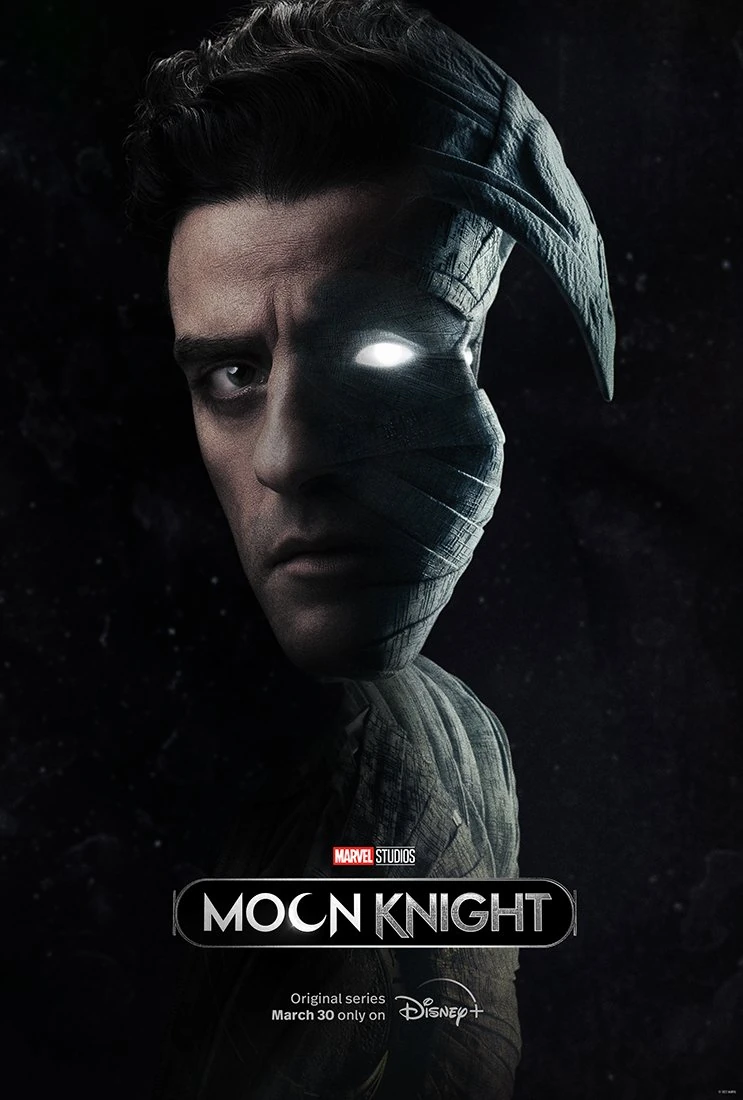
Director's Mohamed Diab as well as Justin Benson & Aaron Moorshead's direction is stylish and the score by Hesham Hazih is haunting and captures the dread and terror that is the titular character himself. The locations are stunningly beautiful; the Egypt setting in particular brings out a richness and a texture that sets it apart from the rest of the MCU. The special effects are terrific, the action scenes are brutal, intense and well choreographed. Because this is Disney+ show with a darker tone compared to what came before, the filmmakers have the freedom to get away with a lot more than a theatrical release. There's an uncompromising sing nature to the action that you just don't get from other MCU properties with the possible exception of the Daredevil Netflix series. The cinematography is winsome and captures the exoticness and beauty of the Egyptian setting. The production design is terrific: Steven’s apartment is set in an attic which recalls the shape of a pyramid; his bed gives off the sense he’s in a sarcophagus as if he’s a bit tombed in. Even the Egyptian locations such Alexander the Great’s burial chamber and the Pyramids of Giza are given so much texture and detail that ads to the authenticity things like the statues and sculptures for the Gods, the tailing and the murals, it’s this level of detail that the filmmakers live for. The costumes are fantastic, The Mr. Knight costume is what Steven imagines is cool. Something akin to James Bond - a dapper gentleman who’s a trickster and strong as well as funny. The Moon Knight suit itself looks absolutely gorgeous, giving off the impression that it looks like wrapped bandages.
Oscar Isaac delivers a fierce and remarkable performance playing two (maybe three) minds trapped in a single body. Not since Daredevil has a superheroes disability been brought to the forefront of a superhero narrative. He finds that he has two (maybe three) people living inside of him. As Steven Grant, he's a quirky, bumbling museum gift shop employee; he's out in. Grant doesn’t have great social skills and is longing for connection. But as Marc Spector, he's a brutal, uncompromising and ruthless mercenary who serves as the avatar for the Egyptian moon god Khonshu.
Both Grant and Spector clash when the two personalities first become aware of each other which leads to a lot of funny moments mainly with them fighting control over the body. Over the course of the show, there’s the feeling of a brotherly relationship between the two of them even though they are technically the same person, paternal even. Ultimately, the story becomes about unifying these two sides to himself. They sort of complete each other in some funny way.
Ethan Hawke makes for a intimidating and charismatic villain playing Cult Leader Arthur Harrow, expertly nailing the character's manipulative, cultive personality and it's plausible that others would follow him on his quest. He believes that people should be judged and accordingly punished not just for the evil they’ve committed but for the evil they have yet to commit. Whereas Marc is the Avatar for Khonshu whose job is to avenge wrongdoing where Arthur Harrow is working for the goddess Ammit whose goal is to eliminate all wrongdoing. Think Minority Report with Egyptian mythology thrown in for good measure. What tips him into the fanatic point is that he doesn’t believe in forgiveness; that people can grow, change and get better. From his perspective a weed is a weed: It’s going to kill what’s good and lets just nip it in the bud.
May Calamawy also impressed playing Layla El-Faouly, although she's basically an amalgamation of Marlene Alraune, Marc Spector's love interest from the comics and the Scarlet Scarab character from the comics. Layla is very much Marc's wife and partner thereby being his equal in many regards. Calamawy brought the right amount of feistiness and determination to the role.
F. Murray Abraham is very powerful playing the Egyptian Moon God Khonshu and provides the gravitas and strong sense of authority required for the role. An imperious, ruthless and vengeful deity who uses people for his own desires and often has little to no remorse for what fate might wait those whom he chooses as Avatars. Khonshu which means “traveler” in ancient Egyptian, is the protector of the travellers of the night and he’s there to keep the balance in the universe. There is literal side of Khonshu and then there’s the metaphor which is the embodiment of Marc’s rage. His rage at what has happened to him as a child and his rage at himself that feels that he deserves it in some way and that he has to be a Slave to, that he has no choice, almost like an addiction.
He's aided by the devotion many have to him, the almost cult-like way He's also unselfish and willing to sacrifice himself the same way he demands sacrifice from others.
One cast member that doesn't come into play until late into the series is Antonia Salib playing Taweret, the Egyptian Godess of Women and Children. Her sunny and optimistic nature coupled with Salib's dulcet voice bring some much needed levity to an other bleak and dark show.
Moon Knight shines bright in the darkness, 4.5/5.
The Anonymous Critic.


Comments
Post a Comment